Tip
All input files can be downloaded: Files.
eda
This keyword defines how to perform an energy decomposition analysis (EDA) calculation.
Options
- type
Value
tsofor block localized wavefunction energy decomposition analysis (TSO-EDA).gksfor generalized Kohn-Sham energy decomposition analysis (GKS-EDA).mb_tsofor many-body interaction TSO-EDA.mb_gksfor many-body interaction GKS-EDA.msedafor multi-state energy decomposition analysis (MS-EDA) for exciplexes.Default
None
Both GKS-EDA and TSO-EDA is available for intermolecular interaction analysis. Furthermore, combined with the many-body expansion scheme, two new methods, i.e. many-body GKS-EDA and many-body TSO-EDA, are available for the analysis of many-body interactions.
In Qbics, we recommend to use TSO-EDA for EDA calculations.
- frag
This option defines the fragments’ partition of an system. The format is:
frag num_electrons spin_multiplicity atom_rangewhich is the same as the keyword
fraginscfguessoption. See scfguess.
- nobsse
Do not do the Boys and Bernardi’s counterposise (CP) correction for basis set superposition error (BSSE). Qbics does BSSE correction by default. You can use this keword to avoid it when you don’t need to consider BSSE.
- tso_for_guess
Do TSO calculation first for the initial guess of fragments’ wavefunction, which is necessary for the case there are fragments with C∞ group symmetry such as an atom.
For
tso`andmb_tso, this is default. While forgksandmb_gks, this is optional.
- mb_level
Value
An integer
Default
2Truncation level for many-body interaction analysis, i.e.
mb_gksandmb_tsocalculations. The value should NOT be smaller than 2 and equal to or greater than the number of fragments.Usually,
4is a good choice, if the number of fragments is larger than 4. Higher order terms are very small and can be ignored.
Warning
For EDA tasks, you should add type U in the scf keyword to ensure the unrestricted calculation. Otherwish, the calculation will be failed.
- orb1
Must be given for
type msedacalculations. This defines the orbital partition of diabatic excited state of fragment 1. The format is:orb num_electrons spin_multiplicity alpha_MO_indices : beta_MO_indicesThere can be arbitrary number of
orb1, but all orbitals must be included once and only once. They are the same asorbinscfguess. See scfguess.
- orb2
Must be given for
type msedacalculations. This defines the orbital partition of diabatic excited state of fragment 2.
- orb
Must be given for
type msedacalculations. This defines the orbital partition of excited state of the whole molecule.
Theoretical Background
Hint
If you use tso and mb_tso, please cite the following reference:
If you use gks and mb_gks, please cite the following reference:
If you use mseda, please cite the following reference:
TSO-EDA
TSO-EDA is based on target state optimization self-consistent field method (J. Chem. Theory Comput. 2023, 19, 1777) and decomposes the total interaction energy into five terms, i.e. electrostatic, exchange, polarization, charge transfer, and dispersion energies. The sum of electrostattic and exchange energy is the Heitler-London term (Phys. Chem. Chem. Phys. 2024, 26, 17549):

Here:
Ectrostatic term: Represents the semiclassical Coulombic interaction of charged particles from different monomers;
Exchange term: Represents quantum effect due to the antisymmetric character of the electronic wave function and the satisfaction of the Pauli exclusion principle;
Polarization term: Represents the polarization of the electron density of one monomer by the presence of other monomer;
Charge transfer term: Represents the charge transfer between monomers;
Dispersion term: Represents the dispersion interaction between monomers.
The BSSE effect is included in charge transfer term. All above terms can be found in Qbics output.
Many-Body TSO-EDA
This method is developed in Phys. Chem. Chem. Phys. 2024, 26, 17549 and is used to analyze the many-body effects in a molecular cluster. The total interaction energy is decomposed into 2-body, 3-body, and higher-order terms, like this:
The terms higher than \(\Delta E^{(2)}\) is the many-body interaction term. Usually the most important one is the three-body effect \(\Delta E^{(3)}\), the effects of which can be decomposed into three ones:
\(\Delta E^{(3)} < 0\): Indicate a cooperative effect of the monomers in a cluster. The many-body interaction is stabilizing the cluster. This is often seen in hydrogen bonding clusters, like water clusters.
\(\Delta E^{(3)} > 0\): Indicate an anti-cooperative effect of the monomers in a cluster. The many-body interaction is destabilizing the cluster. This is often seen in a cluster of charged species, like ionic liquid clusters. Also see below.
\(\Delta E^{(3)} \approx 0\): Indicate a non-cooperative effect of the monomers in a cluster. There is little many-body interaction in the cluster. This is often seen in a cluster of molecules without charges or hydrogen bonds.
Each order can be decomposed into electrostatic, exchange, polarization, charge transfer, and dispersion terms:
Usually, electrostatic and exchange terms are highly additive, while polarization and charge transfer terms are non-additive. The dispersion term is always additive.
Multi-State EDA for Exciplexes
This method is developed in JACS Au 2023, 3, 1800-1819. and J. Phys. Chem. Lett. 2023, 14, 2917-2926. and is used to analyze the nature of exciplexes. We will calculate the following 4 energy components:
\(\Delta E_{\text{Lint}}\): Local interaction energy between the two fragments.
\(\Delta E_{\text{exciton}}\): The local exciton energy of the fragments of the exciplex.
\(\Delta E_{\text{superexchange}}\): The charge transfer effect between the two fragments.
\(\Delta E_{\text{OCD}}\): The oribtal-configuration delocalization (OCD) effects over the whole molecule.
The exact mathematical expressions can be found in JACS Au 2023, 3, 1800-1819. Below is a graph to show how the calculate each term, althgouth they can be automatically done by Qbics.
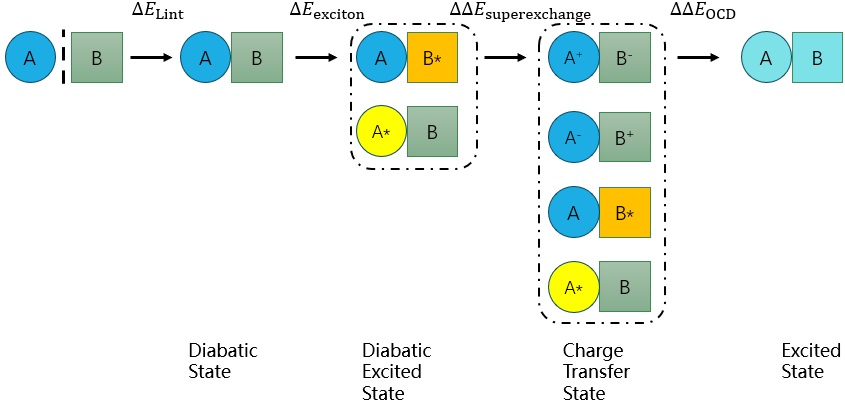
\(\Delta E_{\text{Lint}}\): For the complex AB, we calculate the diabatic state [A][B], where the wave functions are localized on each fragment. Its calculation by TSO-DFT can be found in scfguess and TSO-DFT (2): Diabatic States.
\(\Delta E_{\text{exciton}}\): Two states [A][B*] and [A*][B] are calculated (assigned by
orb1andorb2). For [A][B*], A is in the ground state and B is in the excited state. [A*][B] is in the same way. They are the so-called local exciton states. They can be combined by NOSI method to get exciton state a[A][B*]+b[A*][B].\(\Delta E_{\text{superexchange}}\): Two charge transfer states [A+][B-] and [A-][B+] are calculated. They can be combined by NOSI method with the exciton state to get the superexchange state a[A][B*]+b[A*][B]+c[A+][B-]+d[A-][B+].
\(\Delta E_{\text{OCD}}\): The standard excited state. It can be calculated by TSO-DFT with the orbital partition
orb. Examples are shown in TSO-DFT (1): Excited States.
Here, we give a brief list to show how to use these energies to identify the nature of exciplexes:
\(\Delta E_{\text{superexchange}}\approx 0,\Delta E_{\text{OCD}}\approx 0\): The exciplex is called encounter exciplex. This means that the exciplex is actually a combination of two fragments, and one fragment is excited while the other is not.
\(\Delta E_{\text{superexchange}} < -1\) eV: The exciplex is called charge-transfer exciplex. This means that in this exciplex, one electron of one fragment is transferred to the other fragment.
\(\Delta E_{\text{OCD}} > 0.4\) eV: The exciplex is called intimate exciplex. This means that in this exciplex, the two fragments are strongly coupled, and the electronic wavefunction is delocalized over the whole molecule.
While type mseda in Qbics is quite automatic, unfortunately, you have to design the intermediate diabatic excited state manually and carefully.
Input Examples
Example: EDA for GeH3F-NCH Complex by B3LYP-D3BJ/def2-SVP
For the complex GeH3F-NCH, we can do EDA calculation by the following input:
 1mol
 2   Ge      0.00000000      0.00221863     -0.79935317
 3    H      0.00000000      1.48645043     -0.40384625
 4    H      1.28514604     -0.74161126     -0.40477816
 5    H     -1.28514603     -0.74161126     -0.40477816
 6    F      0.00000000      0.00108752     -2.56116087
 7    C      0.00000000     -0.00225138      3.35662076
 8    H      0.00000000     -0.00220444      4.43604901
 9    N      0.00000000     -0.00207825      2.20326200
10end
11
12basis
13    def2-svp
14end
15
16scf
17    charge  0
18    spin2p1 1
19    type    U # For EDA calculations, this must be added explicitly.
20end
21
22grimmedisp
23    type bj
24end
25
26eda
27    type tso # You can also change it to: gks
28    frag 0 1 1-5  # Define GeH3F.
29    frag 0 1 6-8  # Define HCN.
30end
31
32task
33    eda b3lyp
34end
The atom indices are shown below:

The results are:
1WITH BSSE correction:
2Electrostatic interaction energy:                  -4.98 kcal/mol
3Exchange-correlation interaction energy:            4.22 kcal/mol
4Polarization interaction energy:                   -0.62 kcal/mol
5Charge transfer interaction energy:                -1.31 kcal/mol
6Grimme's dispersion interaction:                   -1.58 kcal/mol
7----------------------------------------------------------------
8Total interaction energy:                          -4.27 kcal/mol
1WITH BSSE correction:
2Electrostatic interaction energy:                  -6.22 kcal/mol
3Exchange interaction energy:                       -9.64 kcal/mol
4Repulsion interaction energy:                      15.94 kcal/mol
5Polarization interaction energy:                   -2.52 kcal/mol
6Correlation interaction energy:                    -0.24 kcal/mol
7Grimme's dispersion interaction:                   -1.58 kcal/mol
8----------------------------------------------------------------
9Total interaction energy:                          -4.27 kcal/mol
We can see that the total interaction energies (with or without BSSE) are the same for both TSO-EDA and GKS-EDA methods, but components are different. As mentioned, Qbics recommends TSO-EDA for calculations. This complex is stabilized by Electrostatic interaction eneregy, which is compatible with the chemical intuition that it is stabilized by sigma-hole.
Example: MB-EDA for Molecular Cluster (NH4+)2(H2SO4)(HSO4-)2
The title cluster is composed of two NH4+ cations, one H2SO4 molecules, and two HSO4- anions. This cluster is used in the study of atmopheric chemistry.We can do MB-EDA calculation by the following input:
 1basis
 2    def2-svp
 3end
 4
 5scf
 6    charge     0 # Total charge.
 7    spin2p1    1
 8    type       U
 9end
10
11grimmedisp
12    type bj
13end
14
15eda
16    type      mb_tso
17    mb_level  4
18    frag  +1 1 1-5   # NH4+
19    frag  +1 1 6-10  # NH4+
20    frag   0 1 11-17 # H2SO4
21    frag  -1 1 18-23 # HSO4-
22    frag  -1 1 24-29 # HSO4-
23end
24
25mol
26 N                  0.13124700   -1.86033100   -1.49054300
27 H                 -0.68471400   -1.96085700   -0.84840100
28 H                  0.16284500   -2.63375000   -2.14527600
29 H                 -0.00155300   -0.97157900   -1.98611500
30 H                  1.02982000   -1.79400200   -0.97437700
31 N                 -1.89606400    2.02266900    1.95536400
32 H                 -2.33766600    1.07911300    1.78190600
33 H                 -1.20423600    1.92734800    2.69193100
34 H                 -1.40455300    2.34660500    1.08417600
35 H                 -2.60508400    2.69280200    2.23215700
36 S                  3.40269500   -0.73966700    0.43845300
37 O                  4.56636300   -1.26003200    1.03924300
38 O                  2.66268100   -1.55477200   -0.49575900
39 O                  2.42657400   -0.30120000    1.56959800
40 O                  3.78755300    0.58843400   -0.27018200
41 H                  2.99297400    1.01172300   -0.68798600
42 H                  1.56137200   -0.00498400    1.17228000
43 S                 -3.05756300   -0.82805000    0.17173500
44 O                 -2.21824200   -1.98280100   -0.09354400
45 O                 -3.00471800   -0.39464500    1.56194000
46 O                 -2.90973700    0.26502300   -0.77053900
47 O                 -4.55472700   -1.30387800   -0.08712900
48 H                 -4.73898300   -2.05912100    0.48328300
49 H                 -1.51856700    0.72871100   -1.53329100
50 S                  0.24159900    1.52238500   -0.65825900
51 O                 -0.59336700    0.90131200   -1.85962900
52 O                  1.55183900    1.72430300   -1.22252400
53 O                 -0.45708500    2.72297400   -0.23978600
54 O                  0.20716100    0.49864900    0.39894800
55end
56
57task
58   eda b3lyp
59end
The atom indices are shown below, which is used to define the fragments frag:

The results are:
 1Table 5. Summary (kcal/mol).
 2---------------------------------------------------------------------------------------------------------------------------------
 3    Interactions         delE_el         delE_xc         delE_pl         delE_ct       delE_bsse       delE_disp        delE_tot
 4---------------------------------------------------------------------------------------------------------------------------------
 5   SUM of 2-body -3.51853640E+02  1.04231044E+02 -5.50310217E+01 -9.70290703E+01  4.35696096E+01 -1.98079059E+01 -3.75920984E+02
 6   SUM of 3-body  1.72107484E-09  1.45358519E+00  2.82254671E+01  2.81735373E+01 -1.24450163E+01  1.01531078E-02  4.54177264E+01
 7   SUM of 4-body -4.14670076E-09  1.70212282E-02 -2.25462767E+00 -5.15894065E+00  1.89758583E+00  2.28017787E-05 -5.49893846E+00
 8          Remain  7.51748885E-09 -8.58522126E-04  6.43113307E-02  4.30266615E-01 -1.22896862E-01  5.97720460E-07  3.70823167E-01
 9---------------------------------------------------------------------------------------------------------------------------------
10             SUM -3.51853640E+02  1.05700792E+02 -2.89958710E+01 -7.35842070E+01  3.28992822E+01 -1.97977294E+01 -3.35631373E+02
11---------------------------------------------------------------------------------------------------------------------------------
We can see that the total interaction energy is -335.63 kcal/mol, which is decomposed into 2-body, 3-body, 4-body, and remaining terms. The 2-body term is the most important one (-375.92 kcal/mol), while the 3-body term is also significant, but anti-cooperative (destablizing the complex) (+45.42 kcal/mol). The 4-body term is small (-5.50 kcal/mol, slightly cooperative). The remaining term (sum of 5- and 6-body) is very small (+0.37 kcal/mol) and can be ignored.
We can also see that the electrostatic and exchange energy are highly additive, while the polarization and charge-transfer energy are non-additive. For different kinds of clusters, the 3-body effects (many-body interactions) can be quite different, see Phys. Chem. Chem. Phys. 2024, 26, 17549 for more information.
Example: MS-EDA for Excited State of (H2O)2
Tip
For a complete tutorial of MS-EDA, please refer to:
Here, we give an exmaple to show how to use MS-EDA to analyze the nature of excited state of (H2O)2.
 1mol
 2O            2.25695562672726        4.09092939425841        1.44708469612963
 3H            2.60549948258352        4.95596113201443        1.66737912969664
 4H            1.70005657505238        3.82479696706390        2.19401386768222
 5O            0.46185891193345        3.08059831055055        3.39436520556125
 6H            0.75871260498951        2.17908731297165        3.53934447614016
 7H           -0.35008320128635        3.03362688314125        2.88381262479031
 8end
 9
10basis
11    cc-pvdz
12end
13
14scf
15    charge  0
16    spin2p1 1
17    type    u
18end
19
20eda
21    type mseda
22    frag 0 1 1-3
23    frag 0 1 4-6
24    # Orbital partition for fragment 1
25    orb1 10 1 1-4 6-24 : 1-23
26    orb1  0 1        5 : 24
27    orb1 10 1    25-48 : 25-48
28    # Orbital partition for fragment 2
29    orb2 10 1        1-24 : 1-24
30    orb2 10 1 25-28 30-48 : 25-47
31    orb2  0 1          29 : 48
32    # Orbital partition for the whole molecule
33    orb 20 1 1-9 11-48 : 1-47
34    orb  0 1        10 : 48
35end
36
37task
38    eda m062x
39end
Let’s explain the input file:
type mseda: Use MS-EDA.frag 0 1 1-3: This is the fragment assignment for fragment 1.frag 0 1 4-6: This is the fragment assignment for fragment 2.
The following 3 lines indicate a diabatic state that fragment 1 is in the excited state and fragment 2 is in the ground state.
1orb1 10 1 1-4 6-24 : 1-23
2orb1  0 1        5 : 24
3orb1 10 1    25-48 : 25-48
The orbital occupation of the diabatic ground state [H2O][H2O] is shown in the left panel, which is caculated automatically by Qbics. Then, the local exciton (diabatic excited state) state [H2O*][H2O], where the first water is excited (5 → 6) while the second one is in the ground state, assigned by orb1, is shown in the right panel.
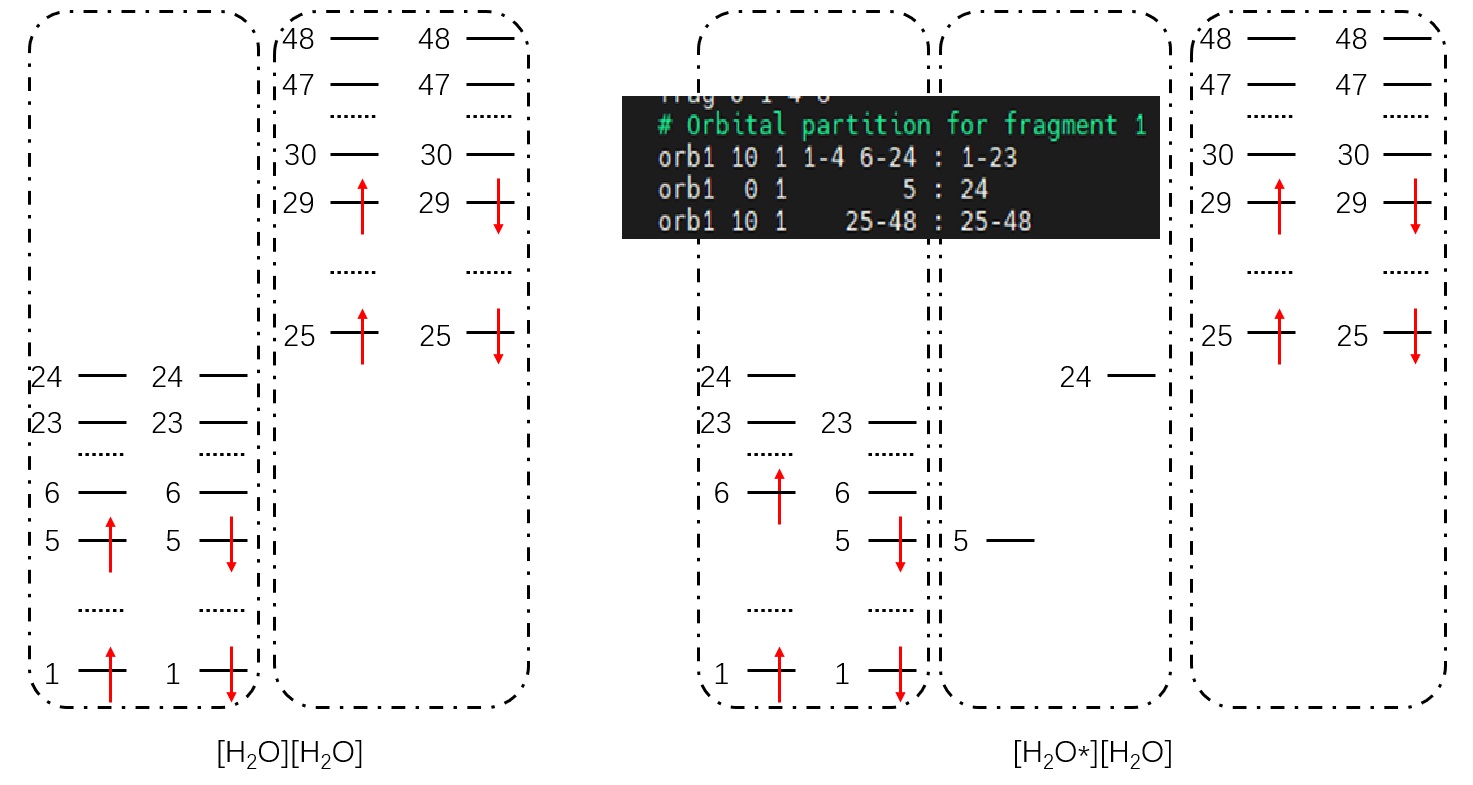
The another local exciton state [H2O][H2O*], where the second water is excited while the first one is in the ground state, assigned by orb2.
Finally, the standard excited state (H2O)2* (10 → 11) is assigned by orb. The charge transfer states will be calculated automatically by Qbics.
Now, after calculation, the results are:
 1---- NOSI Results ----
 2======================
 3   State   NOSI Energies  Excited Energy       Osc. Str.        DX        DY        DZ
 4               (Hartree)            (eV)                    (a.u.)    (a.u.)    (a.u.)
 5       0   -152.49573626      0.00000000      0.00000000  71.07190 190.55904 130.28574
 6       1   -152.49513363      0.01639767      0.00021144   0.37783   0.89791   0.32667
 7       2   -152.46935243      0.71790407      0.00000000   0.00000   0.00000   0.00000
 8       3   -152.46845033      0.74245017      0.00000000  -0.00000  -0.00000  -0.00000
 9
10---- NOSI State Identification (Coefficients) ----
11==================================================
12State |0> = +0.239 |eda-3-Ax.B.mwfn> -0.239 |spin_flip_eda-3-Ax.B.mwfn> +0.666 |eda-3-A.Bx.mwfn> -0.666 |spin_flip_eda-3-A.Bx.mwfn>
13State |1> = +0.666 |eda-3-Ax.B.mwfn> -0.666 |spin_flip_eda-3-Ax.B.mwfn> -0.239 |eda-3-A.Bx.mwfn> +0.239 |spin_flip_eda-3-A.Bx.mwfn>
14State |2> = -0.681 |eda-3-Ax.B.mwfn> -0.681 |spin_flip_eda-3-Ax.B.mwfn> -0.189 |eda-3-A.Bx.mwfn> -0.189 |spin_flip_eda-3-A.Bx.mwfn>
15State |3> = -0.190 |eda-3-Ax.B.mwfn> -0.190 |spin_flip_eda-3-Ax.B.mwfn> +0.681 |eda-3-A.Bx.mwfn> +0.681 |spin_flip_eda-3-A.Bx.mwfn>
16--omitted--
17E[exciton]: You will have to manually select from "NOSI Results" according to "NOSI State Identification (Coefficients)".
18--omitted--
19---- NOSI Results ----
20======================
21   State   NOSI Energies  Excited Energy       Osc. Str.        DX        DY        DZ
22               (Hartree)            (eV)                    (a.u.)    (a.u.)    (a.u.)
23       0   -152.49716659      0.00000000      0.00000000  71.72102 192.27664 131.05811
24       1   -152.49623624      0.02531483      0.00046202  -0.38016  -1.04711  -0.50330
25       2   -152.47228961      0.67690257      0.00000000   0.00000   0.00000   0.00000
26       3   -152.46913953      0.76261617      0.00000000  -0.00000   0.00000   0.00000
27       4   -152.40168515      2.59804997      0.00000000  -0.00000  -0.00000   0.00000
28       5   -152.37292576      3.38059283      0.11715904  -1.09643  -1.11179   0.63183
29       6   -152.37106237      3.43129579      0.00000000  -0.00000  -0.00000   0.00000
30       7   -152.27658033      6.00215210      0.03076888  -0.44092  -0.37968   0.28486
31
32---- NOSI State Identification (Coefficients) ----
33==================================================
34State |0> = -0.607 |eda-3-Ax.B.mwfn> +0.607 |spin_flip_eda-3-Ax.B.mwfn> -0.324 |eda-3-A.Bx.mwfn> +0.324 |spin_flip_eda-3-A.Bx.mwfn> -0.079 |eda-3-A+.B-.mwfn> +0.079 |spin_flip_eda-3-A+.B-.mwfn>
35State |1> = +0.325 |eda-3-Ax.B.mwfn> -0.325 |spin_flip_eda-3-Ax.B.mwfn> -0.611 |eda-3-A.Bx.mwfn> +0.611 |spin_flip_eda-3-A.Bx.mwfn>
36State |2> = -0.669 |eda-3-Ax.B.mwfn> -0.669 |spin_flip_eda-3-Ax.B.mwfn> -0.098 |eda-3-A.Bx.mwfn> -0.098 |spin_flip_eda-3-A.Bx.mwfn> +0.122 |eda-3-A+.B-.mwfn> +0.122 |spin_flip_eda-3-A+.B-.mwfn>
37State |3> = +0.101 |eda-3-Ax.B.mwfn> +0.101 |spin_flip_eda-3-Ax.B.mwfn> -0.676 |eda-3-A.Bx.mwfn> -0.676 |spin_flip_eda-3-A.Bx.mwfn> -0.070 |eda-3-A-.B+.mwfn> -0.070 |spin_flip_eda-3-A-.B+.mwfn>
38State |4> = +0.272 |eda-3-A.Bx.mwfn> +0.272 |spin_flip_eda-3-A.Bx.mwfn> -0.702 |eda-3-A-.B+.mwfn> -0.702 |spin_flip_eda-3-A-.B+.mwfn>
39State |5> = +0.200 |eda-3-Ax.B.mwfn> -0.200 |spin_flip_eda-3-Ax.B.mwfn> -0.711 |eda-3-A+.B-.mwfn> +0.711 |spin_flip_eda-3-A+.B-.mwfn>
40State |6> = -0.234 |eda-3-Ax.B.mwfn> -0.234 |spin_flip_eda-3-Ax.B.mwfn> -0.703 |eda-3-A+.B-.mwfn> -0.703 |spin_flip_eda-3-A+.B-.mwfn>
41State |7> = -0.280 |eda-3-A.Bx.mwfn> +0.280 |spin_flip_eda-3-A.Bx.mwfn> +0.775 |eda-3-A-.B+.mwfn> -0.775 |spin_flip_eda-3-A-.B+.mwfn>
42--omitted--
43E[SE]: You will have to manually select from "NOSI Results" according to "NOSI State Identification (Coefficients)".
44--omitted--
45---- NOSI Results ----
46======================
47   State   NOSI Energies  Excited Energy       Osc. Str.        DX        DY        DZ
48               (Hartree)            (eV)                    (a.u.)    (a.u.)    (a.u.)
49       0   -152.78958902      0.00000000      0.00000000  71.76585 191.51356 130.39299
50       1   -152.50815639      7.65778183      0.00000000  -0.00000  -0.00000   0.00000
51       2   -152.48459764      8.29881531      0.02202111  -0.38172   0.19276  -0.18544
52
53---- NOSI State Identification (Coefficients) ----
54==================================================
55State |0> = -1.000 |eda-3-AB.mwfn>
56State |1> = -0.707 |eda-3-ABx.mwfn> +0.707 |spin_flip_eda-3-ABx.mwfn>
57State |2> = +0.707 |eda-3-ABx.mwfn> +0.707 |spin_flip_eda-3-ABx.mwfn>
58--omitted--
59E[es]: You will have to manually select from "NOSI Results" according to "NOSI State Identification (Coefficients)".
60--omitted--
61MS-EDA Results
62==============
63E[A]+E[B] = -152.77690444 Hartree ->  0.00000 eV (as reference)
64E[A.B]    = -152.78247691 Hartree -> -0.15163 eV
65E[A+.B-]  = -152.38240651 Hartree -> +10.73484 eV
66E[A-.B+]  = -152.36309839 Hartree -> +11.26024 eV
67E[Ax.B]   = -152.48224465 Hartree -> +8.01810 eV
68E[A.Bx]   = -152.48208951 Hartree -> +8.02232 eV
69E[AB]     = -152.78958934 Hartree -> -0.34517 eV
70E[ABx]    = -152.49637681 Hartree -> +7.63355 eV
71
72      delta E_Lint =          E[A.B]-(E[A]+E[B]) = -0.00557247 Hartree = -0.15163 eV
73      delta E_exciton =       E[exciton]-E[A.B]
74delta delta E_superexchange = E[SE]-E[exciton]
75delta delta E_OCD =           E[es]-E[SE]
Below:
Line 63-70: The TSO-DFT energy of the diabatic state (
[A.B]), charge transfer (like[A+.B-]), local exciton (like[A.Bx]), and standard ground ([AB]) and excited state ([ABx]).Line 72-75: \(\Delta E_{\text{Lint}}\), \(\Delta E_{\text{exciton}}\), \(\Delta E_{\text{superexchange}}\), and \(\Delta E_{\text{OCD}}\). Some energies are not calculated because the NOSI solution of exciton, superexchange, and OCD are multiple, and there are some degrees of freedom to choose. One principle is to choose the singlet state with the lowest energy.
To choose
E[exciton], check Lines 3-15. State2is a singlet state of the combination of [A*][B] and [A][B*], so its energy isE[exciton] = -152.46935243Hartree (Line 7).To choose
E[SE], check Lines 17-29. State2is a singlet state of the combination of [A*][B], [A][B*] and [A+][B-], so its energy isE[SE] = -152.47228961Hartree (Line 25).To choose
E[es], check Lines 45-57. State2is a singlet excited state, so its energy isE[es] = -152.48459764Hartree (Line 51).
Tip
Usually, the singlet state is that the coefficients of the wave function and its spin-flip one have the same sign.
Now, the energies can be calculated:
E_Lint = -0.15 eV
E_exciton = (-152.46935243-( -152.78247691))*27.21 = +8.52 eV
E_superexchange = (-152.47228961-( -152.46935243))*27.21 = -0.08 eV
E_OCD = (-152.48459764-( -152.47228961))*27.21 = -0.33 eV
Therefore, the excited state of (H2O)2 is a typical encounter exciplex. It almost has no charge transrfer effect, but has a small OCD effect, due to the formation of hydrogen bond in the dimer.
Tip
In Multi-State Energy Decomposition Analysis for Exciplexes, we will show more examples and some other types of exciplexes.
Besides the output file, you can also find some MWFN files corresponding to the diabatic (eda-3-A.B.mwfn), dibatic excited (eda-3-Ax.B.mwfn, eda-3-A.Bx.mwfn), charge-transfer (eda-3-A+.B-.mwfn, eda-3-A-.B+.mwfn), and standard ground (eda-3-AB.mwfn) and excited state (eda-3-ABx.mwfn).