Qbics Applications
2026
- J. Chem. Theory Comput. 2026, 22, 2390. This paper uses Qbics to predict the K-edge X-ray absorption spectra of a series of molecules. From small molecules to porphyrin and the uranyl ion, MSDFT, in the form of NOSI/TSO-DFT, can give much more reasonable excitation energies and transition dipole moments than LR-TDDFT!
Predict the K-edge X-ray absorption spectra: MSDFT (2): Core Ionizations and Excitations
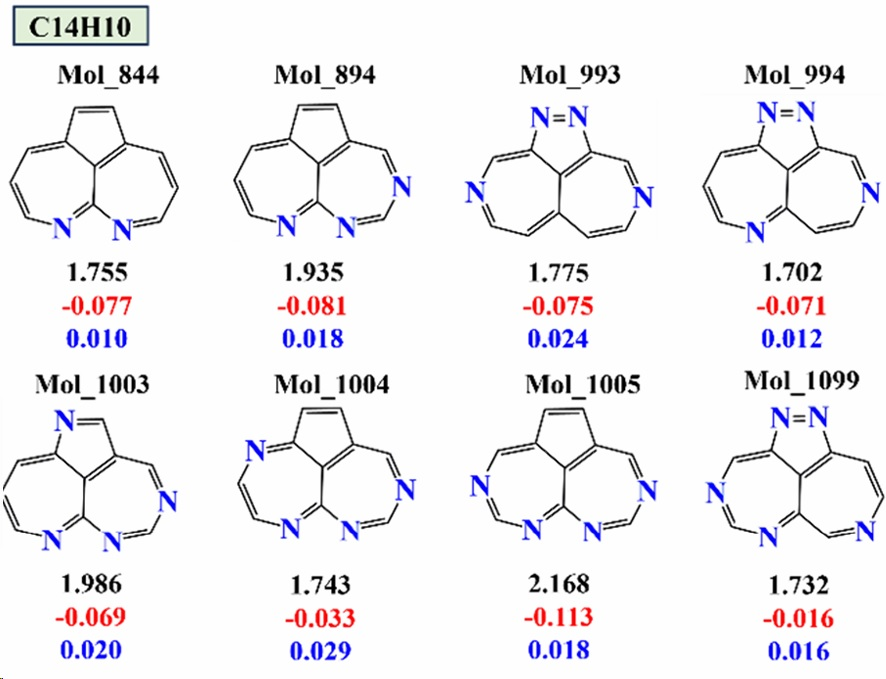
- J. Phys. Chem. Lett. 2026, XX, XX This paper uses TSO-DFT to calculate excitation energies of molecules containing inverted singlet triplet (IST) signatures with the B3LYP functional. For more than 34 molecules, TSO-DFT gives relialbe negative S1-T1 gaps. The paper argues that “The TSO-DFT methodology (with the B3LYP functional), benchmarked against experimentally reported and theoretically proposed IST molecules, shows superior accuracy in predicting negative ΔEST compared to standard EOM-CCSD and ADC(2) methods, establishing it as a uniquely cost-effective tool for IST emitter design.”
Reproduce the results of this paper: Inverted Singlet-Triplet (IST) Energy Gap Using TSO-DFT
2025
- Angew. Chem. Int. Ed. 2025, 64, e202514768. This paper uses Qbics to perform molecular dynamics simulation of monomer liquids appeared in dual-engineered DPP polymers.
Standard Molecular Dynamics Simulations and keyword md.
- J. Comput. Chem. 2025, 46, e70114 This paper uses many-body energy decomposition analysis (MB-EDA) to analyze the complexation mechanism in LiH:nNH3 (n=1-4) clusters.
To use MB-EDA method: MB-EDA tutorial.
2024
Mater. Today Chem. 2024, 36, 101980 In these 3 papers, Qbics was applied to calculate wavefunctions of some passivators used in the treatment of inverted CsPbI2Br perovskite surface. The wavefunctions were used to do electrostatic potential (ESP) analysis.
2023
Nat. Plants 2023, 9, 1547 This paper reveals the allosteric regulation mechanism of the major light-harvesting complex of photosystem II (LHCII). Qbics uses TSO-DFT (See tutorials for excited states and diabatic states.) to calculate the coupling between 2 excited states of LHCII core and this coupling is in highly agreement with the experimentally-measured fluorescence decay rate!